
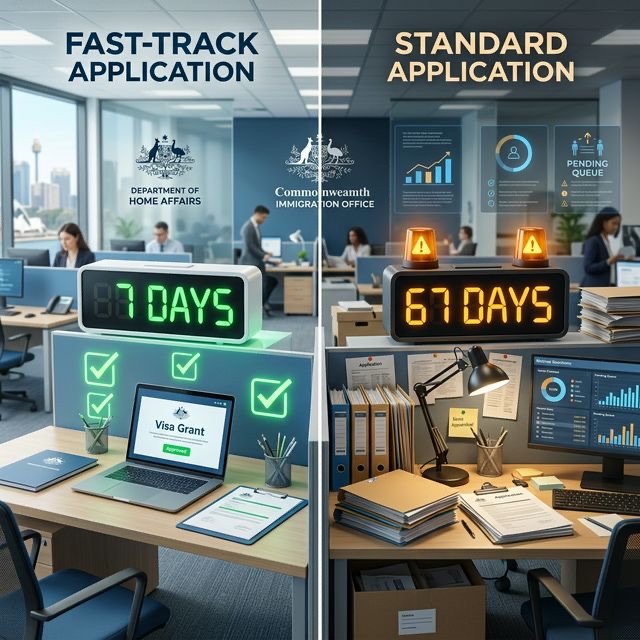
Seven days for Specialist Skills. Twenty-one days for Core Skills. Those are the Department of Home Affairs' processing targets for the Skills in Demand (SID) visa - and if you've read our guide to the SID 7-day targets, you'll know they sound transformative. But here's what the targets don't tell you: half of all Core Skills applications take 51 days to process, and one in ten waits over three months. For the Subclass 186 permanent residency pathway, some applicants are waiting up to 19 months. The gap between the published targets and the lived experience of employers and workers is significant - and understanding why matters more than knowing the headline number.
The Numbers: Targets vs Reality
The Department publishes processing times as two key percentiles: the median (50% of applications processed within this time) and the 90th percentile (90% processed within this time). Here's what the data actually shows as of March 2026:
SID Visa (482 - Applications Lodged After 7 December 2024)
| Pathway | Target | Median (50th) | 90th Percentile | Gap |
|---|---|---|---|---|
| Specialist Skills | 7 days | 8 days | 67 days | Median close to target, but 1 in 10 waits 2+ months |
| Core Skills | 21 days | 51 days | 3 months | Median is 2.4× the target |
| Labour Agreement | Case-by-case | 41 days | 6 months | No published target, but significant variation |
Legacy 482 TSS (Applications Lodged Before 7 December 2024)
| Stream | Median (50th) | 90th Percentile |
|---|---|---|
| Short-term / Medium-term | 5 months | 8-9 months |
Subclass 186 Employer Nomination Scheme (Permanent Residency)
| Stream | Median (50th) | 90th Percentile |
|---|---|---|
| Direct Entry | 12 months | 18-19 months |
| Temporary Residence Transition (TRT) | 13-14 months | 18-19 months |
| Labour Agreement | 4-5 months | 8-9 months |
These are statistical estimates based on recently finalised applications, not guarantees. Your individual processing time depends on the quality of your application, the complexity of your case, and current departmental workload. Processing times can fluctuate month to month.
Why the Gap Between Targets and Reality?
The 7-day and 21-day targets apply to decision-ready applications - the Department's term for submissions where every document, form, and piece of evidence is complete and correct at lodgement. In practice, several factors push applications well beyond those benchmarks:
1. Incomplete Applications
The single biggest cause of delays. Under the Department's new AI-assisted triage system, applications missing key documents - health examinations, police clearances, skills assessment outcomes, or employment contract details - are either flagged for additional information requests or deprioritised entirely. Every request for further information typically adds 4-8 weeks to processing time.
2. Health Check Backlogs
Panel clinic appointment availability varies significantly by location. Applicants in some countries face 3-6 week waits just to book a medical examination, and results can take a further 2-4 weeks to reach the Department. If the Department requests additional health assessments (chest X-rays, specialist referrals), the clock resets.
3. Security and Character Checks
External security checks conducted by ASIO and the Australian Federal Police operate on their own timelines. The Department cannot finalise a visa decision until these checks are complete, and complex cases - particularly involving applicants from certain countries or with extensive travel histories - can take months.
4. Occupation and Salary Scrutiny
The Department is paying closer attention to whether a nominated position genuinely matches the ANZSCO code claimed, and whether the guaranteed annual earnings meet the relevant threshold. Where a case officer has doubts - for example, a job description that reads more like a generic template than a genuine position - expect a request for additional evidence. Use the ANZSCO Occupation Search to verify your occupation code matches your actual role before lodging.
5. Volume Surges
Processing targets assume a steady flow of applications. When policy changes trigger lodgement surges - such as the December 2024 SID commencement or the upcoming July 2026 salary threshold increases - the Department's processing queue expands, and actual times blow out.
The 186 Bottleneck: PR Is Taking Longer Than Ever
The transition from SID visa to permanent residency through the Subclass 186 Employer Nomination Scheme is where delays hit hardest. Under the Temporary Residence Transition (TRT) stream, workers who have completed two years of employment with their sponsoring employer can apply for PR - but the decision itself can take another 13-19 months.
This creates a practical problem: health examinations and police clearances are typically valid for 12 months. If you submit them with your 186 application and the decision takes 18 months, the Department will ask you to redo them - adding cost, time, and frustration.
| Planning Factor | Impact |
|---|---|
| Health check validity | 12 months - may expire before 186 decision |
| Police clearance validity | 12 months - same risk |
| SID visa expiry | Need sufficient visa validity to cover 186 processing time |
| Salary threshold changes (1 July annually) | Lodge before threshold increases to lock in lower requirements |
If you are planning a 186 TRT application, discuss timing strategy with your migration agent. Lodging too early (before the 2-year qualifying period completes) risks refusal. Lodging too late risks salary threshold increases and expired medical/police clearances. Getting the timing right is critical.
New Tool: ImmiAccount Real-Time Tracking Dashboard
On 18 March 2026, the Department launched a real-time visa tracking dashboard within ImmiAccount as part of a two-year digital modernisation project. For the first time, applicants can see more than just "Received" or "In Progress" - the dashboard provides:
- Live progress bar showing where your application sits in the processing pipeline
- Queue position so you know where you stand relative to other applications
- Personalised estimated decision date generated by AI, updated every 24 hours
- Case officer alerts - real-time notification when a case officer views your file, requests documents, or flags a biometrics issue
- Missing document prompts - AI-assisted alerts that immediately flag incomplete items
Which Visas Are Covered?
The dashboard currently supports:
- Subclass 482 (Skills in Demand / TSS)
- Subclass 500 (Student)
- Subclass 186 (Employer Nomination Scheme)
- Several smaller employer-sponsored and temporary categories
Partner visa (820/309) and parent visa queue tracking is expected by July 2026, along with push notifications via the myGov app.
How to Access It
- Log in to your ImmiAccount at immi.homeaffairs.gov.au
- Navigate to your current application
- The tracking dashboard appears automatically for supported visa types
- The estimated decision date refreshes every 24 hours
What It Means for Employers
For HR managers tracking sponsored employee applications, the dashboard removes the guesswork. Instead of calling your migration agent for weekly status updates, you can monitor progress directly. If the estimated date starts slipping, that's your cue to check whether additional documents have been requested.
How to Minimise Your Processing Time
While you can't control departmental workload or security check timelines, you can control the quality of your application. Here's how to stay out of the 90th percentile:
For Employers
- Submit decision-ready nominations - every document complete, every form filled, SAF levy paid at lodgement. No shortcuts.
- Align job descriptions with ANZSCO codes - generic descriptions trigger scrutiny. Be specific about duties, reporting lines, and why this role requires a sponsored worker.
- Provide genuine market salary evidence - the contract must show guaranteed annual earnings above the relevant threshold (currently $76,515 for Core Skills or $141,210 for Specialist Skills, rising to $79,499 and $146,717 from 1 July 2026).
- Ensure current Labour Market Testing - stale advertisements are a rejection trigger.
For Sponsored Workers
- Complete health examinations early - book your panel clinic appointment as soon as your employer confirms they will nominate you. Upload the HAP ID with your visa application.
- Get police clearances from every country - if you've lived in multiple countries for 12+ months each, get all clearances started simultaneously. Some countries take months to issue.
- Provide a skills assessment upfront - don't wait for the Department to request it.
- Use the ImmiAccount dashboard - monitor your estimated decision date. If it's slipping, proactively check for outstanding document requests.
For 186 PR Applicants
- Time your health and police checks strategically - submit them as close to lodgement as possible to maximise validity, but ensure they're ready when you lodge.
- Lodge as soon as you complete the qualifying period - delays in lodgement after the 2-year (or 3-year for legacy 482) qualifying period are wasted time.
- Consider the July salary threshold risk - if you're close to a financial year boundary, lodging before 30 June locks in the current threshold.
Read the Targets, Plan for Reality
Our SID visa processing targets guide explains how the 7-day and 21-day benchmarks work and what "decision-ready" means. This article is the counterpoint - the reality check. The targets are aspirational for the Department, and achievable for genuinely complete applications. But the data shows that many applications aren't hitting those marks. The gap between target and reality is where professional support makes the most difference.
How First Migration Can Help
At First Migration Service Centre, we don't just help you lodge - we help you lodge decision-ready. Our registered migration agents prepare applications designed to hit the fastest processing tiers by ensuring every document, every form, and every piece of evidence is complete and correct before submission.
Our employer-sponsored visa services include:
- Pre-lodgement application audits to identify and fix potential delay triggers
- ANZSCO code verification and genuine position evidence preparation
- Coordinated health, police, and skills assessment timing strategies
- 186 PR transition planning with health check validity management
- ImmiAccount dashboard monitoring and proactive follow-up
Ready to take the next step? We invite you to submit a free visa assessment so we can review your sponsorship case and advise on the fastest path to a decision.
RMA R. Weng
MARA 1569835Registered Migration Agent | Master of Laws (ANU) | Bachelor of Laws (Deakin)
Certified by the Migration Agents Registration Authority (MARA). Specializing in skilled migration, employer-sponsored visas, and partner visas. Admitted to practice law in Victoria.
Related Articles

Disclaimer: This information is general in nature and does not constitute formal migration advice. Immigration laws and policies change frequently. Always consult a MARA-registered migration agent for advice specific to your circumstances. First Migration Service Centre (MARA 1569835) provides this content for informational purposes only.
MARA Registered Agent
Registration No. 1569835
Certified by the Migration Agents Registration Authority. Your trusted partner for Australian visa applications.

South Australia DAMA Expires 30 September 2026: What the Deadline Means and Whether You Should Lodge Before It
What the 67-Day 189 Blackout Actually Means (And What It Does Not)
South Australia Skilled Migration Reopens 26 August 2026: What 190/491 Applicants Should Check Before Lodging
Onshore vs Offshore in 2026: How Location Sets Your Queue Position

Adding a Dependent Child Over 18 to Your Australian Visa (2026)
Office Hours
Mon-Fri: 9AM-5PM Sat: 10AM-2PM